Non Fiction
Dance of the Nomad: A study of the selected notebooks of A.D. Hope by Ann McCulloch
Here is an entry in one of A.D. Hope’s notebooks: it is from 1961: ‘Ingenious devices for letting in the light without allowing you to see out, such as modern techniques provide – e.g., glass brick walls, crinkle-glass, sanded glass and so on – remind me very much of most present-day forms of education.’ This is a representative passage from the notebooks. Lucid itself, it bears on elements of frustration or nullification in experience. As such, it testifies to Hope’s recurrent sense that human beings can easily mislocate their ingenuity, with results that are both memorable and regrettable. In a later notebook, in 1978, speaking of the labyrinth as a model of human life, he writes: ‘Looking back one sees that comparatively trivial blind choices have often determined one’s course and that the majority of people do end up in blind alleys.’ One might contest the generalisation, but will not easily forget the analogy.
... (read more)Clara’s Witch by Natalie Andrews & Midnight Water by Gaylene Perry
With biography and memoir, it seems that readers are buying a certain kind of truth –call it authenticity, the authority of fact. Yet all reading is escapism, even when we are escaping to what we consider true; even in non-fiction, we seek some of fiction’s satisfactions. This is the challenge: to find a theme and structure that will shape the story without sacrificing a sense of intransigent reality.
... (read more)Great Southern Land: A New History of Australia by Frank Welsh
Frank Welsh is ill-served by his publicists. His history of Australia, we are told, is the first to be written by a non-Australian. It is not: the American Hartley Grattan wrote probably the best of a number of earlier such works. Great Southern Land is trumpeted as drawing on sources from Britain, the US, South Africa and Canada to place Australia fully in a world context: in fact, it incorporates some material from British archives and fragments from elsewhere to illustrate Australia’s more obvious international links.
... (read more)Core of My Heart, My Country: Women’s sense of place and the land in Australia and Canada by Maggie MacKellar
In 1830, Georgiana Molloy stepped ashore at the remote settlement of Augusta, accompanying her husband to a new life in Western Australia. Maggie MacKellar tells us that:
Three weeks later, in the month of May, when in England spring bursts from every hedgerow, Georgiana lay on a plank of wood in her tent, with an umbrella held over her to keep off the drips that leaked in through the canvas. Outside the rain poured down. There was no sweet scent of spring; instead the air was filled with the rank, harsh smell of eucalyptus. Around her the earth opened itself to welcome the winter season. Racked with contraction after contraction, Georgiana fought to give birth to her first child.
... (read more)Vote ‘No’, some republicans said at the 1999 republican referendum, and then we will work towards a republic that is a better one than the one being put forward. When the referendum failed, many of those republicans disappeared, and the movement lost momentum. Others who campaigned hard for a Yes vote have continued to push the republican agenda along. A similar group of tenacious Australians is undeterred by the federal government’s sidelining of the reconciliation process. Since joining Australians for Native Title and Reconciliation or their local reconciliation groups, they have maintained the commitment to social justice for indigenous people that they demonstrated when they walked across the bridge or signed the ‘Sorry books’.
... (read more)Between The Rock and a Hard Place: Being Catholic today by Paul Collins
There is a moment in this book where Paul Collins finds himself on a public bus somewhere between Queanbeyan and Canberra. The phone rings. The caller is Morris West, the author, who, in the years before his death in 1999, became a kind of cardinal in the hierarchy of dispossessed Catholics. West had heard that Collins was in a spot of bother over his views on the papacy and had rung to lend sympathy and support.
... (read more)Not Happy, John! Defending Our Democracy by Margo Kingston & Axis of Deceit by Andrew Wilkie
Governments lie, as the veteran US journalist I.F. Stone used to remind us. Worse than that, some of them now defy with impunity the clearly stated wishes of the majority – and international agreements, too. We seem to have entered an era in which the meaning of democracy is being alarmingly redefined. Let us hope it is merely a passing phase.
... (read more)The Trouble with abundance is that there is so much of it. Images, words, ideas and stories spill untidily out of this book like fruit and veg from a cornucopia, which I’m sure is exactly the effect that Marion Halligan was after.
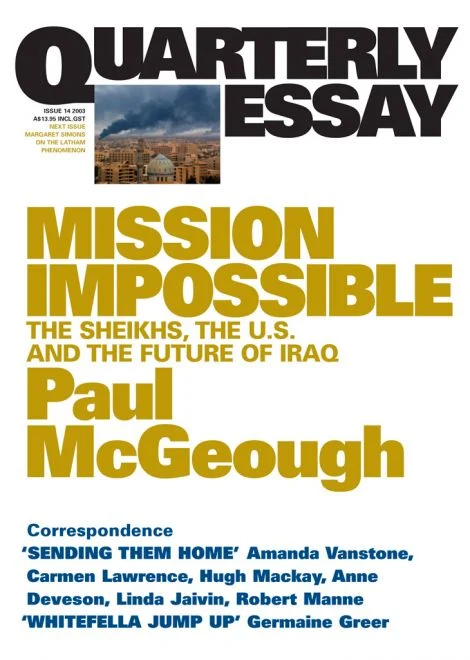
... (read more)Mission Impossible by Paul McGeough & Long Drive Through a Short War by Peter Wilson
These two books represent two different stages of what will be remembered as the US occupation of Iraq. Firstly, we have senior News Limited correspondent Peter Wilson’s account of his somewhat hapless adventures on the road to Baghdad during last year’s invasion. He begins by listing the clothing and equipment he plans to take with him, and by explaining why he doesn’t have an opinion on the conflict. He also lets us know that he has a reputation as a ‘hard man’ around the office.
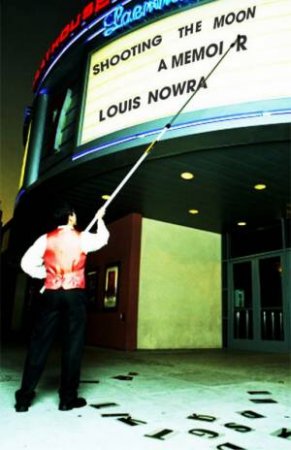
... (read more)Shooting the Moon is Louis Nowra’s second memoir, the follow-up to The Twelfth of Never (1999), which presented its author as a survivor of an intensely dysfunctional family. Nowra’s mother killed her father; his grandmother suffered from mental illness. Not surprisingly, The Twelfth of Never is a study of violence, madness, and self-alienation. It is also immensely entertaining, an odd disjunction that we often see in Nowra’s work.
... (read more)