Non Fiction
Core of My Heart, My Country: Women’s sense of place and the land in Australia and Canada by Maggie MacKellar
In 1830, Georgiana Molloy stepped ashore at the remote settlement of Augusta, accompanying her husband to a new life in Western Australia. Maggie MacKellar tells us that:
Three weeks later, in the month of May, when in England spring bursts from every hedgerow, Georgiana lay on a plank of wood in her tent, with an umbrella held over her to keep off the drips that leaked in through the canvas. Outside the rain poured down. There was no sweet scent of spring; instead the air was filled with the rank, harsh smell of eucalyptus. Around her the earth opened itself to welcome the winter season. Racked with contraction after contraction, Georgiana fought to give birth to her first child.
... (read more)Vote ‘No’, some republicans said at the 1999 republican referendum, and then we will work towards a republic that is a better one than the one being put forward. When the referendum failed, many of those republicans disappeared, and the movement lost momentum. Others who campaigned hard for a Yes vote have continued to push the republican agenda along. A similar group of tenacious Australians is undeterred by the federal government’s sidelining of the reconciliation process. Since joining Australians for Native Title and Reconciliation or their local reconciliation groups, they have maintained the commitment to social justice for indigenous people that they demonstrated when they walked across the bridge or signed the ‘Sorry books’.
... (read more)Between The Rock and a Hard Place: Being Catholic today by Paul Collins
There is a moment in this book where Paul Collins finds himself on a public bus somewhere between Queanbeyan and Canberra. The phone rings. The caller is Morris West, the author, who, in the years before his death in 1999, became a kind of cardinal in the hierarchy of dispossessed Catholics. West had heard that Collins was in a spot of bother over his views on the papacy and had rung to lend sympathy and support.
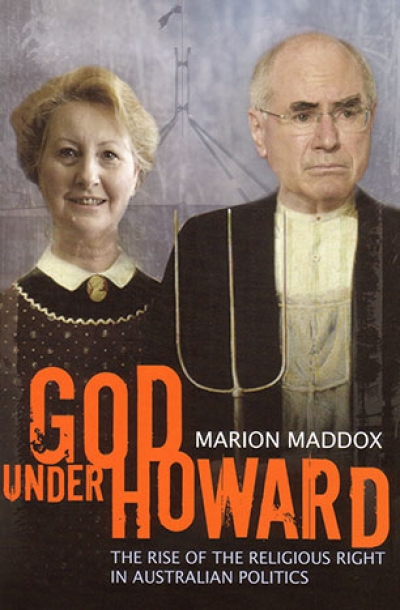
... (read more)Not Happy, John! Defending Our Democracy by Margo Kingston & Axis of Deceit by Andrew Wilkie
Governments lie, as the veteran US journalist I.F. Stone used to remind us. Worse than that, some of them now defy with impunity the clearly stated wishes of the majority – and international agreements, too. We seem to have entered an era in which the meaning of democracy is being alarmingly redefined. Let us hope it is merely a passing phase.
... (read more)The Trouble with abundance is that there is so much of it. Images, words, ideas and stories spill untidily out of this book like fruit and veg from a cornucopia, which I’m sure is exactly the effect that Marion Halligan was after.
... (read more)Mission Impossible by Paul McGeough & Long Drive Through a Short War by Peter Wilson
These two books represent two different stages of what will be remembered as the US occupation of Iraq. Firstly, we have senior News Limited correspondent Peter Wilson’s account of his somewhat hapless adventures on the road to Baghdad during last year’s invasion. He begins by listing the clothing and equipment he plans to take with him, and by explaining why he doesn’t have an opinion on the conflict. He also lets us know that he has a reputation as a ‘hard man’ around the office.
... (read more)Shooting the Moon is Louis Nowra’s second memoir, the follow-up to The Twelfth of Never (1999), which presented its author as a survivor of an intensely dysfunctional family. Nowra’s mother killed her father; his grandmother suffered from mental illness. Not surprisingly, The Twelfth of Never is a study of violence, madness, and self-alienation. It is also immensely entertaining, an odd disjunction that we often see in Nowra’s work.
... (read more)Refuge Australia: Australia’s humanitarian record by Klaus Neumann
Klaus Neumann’s book is the latest in the ‘Briefings’ series from the Institute for Social Research at the Swinburne University of Technology, which explores ‘social, political and cultural issues in contemporary Australia’. This book complements the earlier one in the series, Spencer Zifcak’s Mr Ruddock Goes to Geneva (2003). With access to the National Archives and an acute curiosity to inspect files marked ‘not yet examined’, Neumann sets out to debunk assumptions about Australia’s response to refugees and asylum seekers in the past. He confines himself to case studies pre-dating the formal abandonment of the White Australia Policy, which limited and focused Australia’s response to refugees and asylum seekers.
... (read more)The Web of Science: The Scientific Correspondence of the Rev. W.B. Clarke, Australia’s Pioneer Geologist (2 Volumes) edited by Ann Moyal
The leading early geologist in Australia was Reverend William Branwhite Clarke (1798–1878). His father was a blind schoolmaster in a Suffolk village, and the family was not well off. Still, they managed to send William to Jesus College, Cambridge, where he studied to enter the church. During his time as a student, he came under the influence of the redoubtable professor of geology Adam Sedgwick and took up geology seriously. Nevertheless, he became a clergyman and held a series of minor ecclesiastical positions, besides teaching at his father’s old school for a period. He also undertook geological studies, was elected a Fellow of the Geological Society and published a number of (fairly minor) papers in Britain.
... (read more)Peter Timms is ‘dismayed’ by the state of contemporary art and by the hype that surrounds it and the reality of the experience. He has written a book mired in exasperation and frustration. It is not hard to share Timms’s sentiments. Visit any sizeable biennale-type exhibition and you are engulfed in flickering videos in shrouded rooms, installations of more or less hermetic appeal, large-scale photographs – these often prove to be the most interesting – scratchy ‘anti-drawings’ and a handful of desultory paintings. Noise is ‘in’, too. ‘Biennale art’ is the term frequently used to describe the phenomenon.
Quite who is to blame for this occupies much of the first half of Timms’s book. Artists hell-bent on having careers rather than seeking vocations are part of the problem, and so are curators of contemporary art who nourish the artist’s every need. Art schools are next, where cultural theory has replaced the teaching of art history. The superficialities and the susceptibility to trendiness in the Australia Council are further contributors.
... (read more)