
A Dictionary of Australian Colloquialisms
Sydney University Press, $15
A Dictionary of Australian Colloquialisms edited by G.A. Wilkes
It is not (I hope) a quibble to assert that this splendid new dictionary is misnamed. For it is a dictionary not so much of Australian colloquialisms as of colloquial Australianisms. It would be impossible to represent the colloquial language of Australians adequately without listing as part of it words that are used colloquially all over the English-speaking world but not least in Australia; words like arse, bum, shit, cunt and fuck, and their associated phrases. Yet these don’t appear in Professor Wilkes’s list, not because they are not colloquial, and not because they are vulgar (he sees no point in grading the levels of colloquial usage with labels like ‘low’ or vulg’, p.ix), but apparently because they’re not Australian. Australian, to him, means, first, indigenous expressions, either taken over from the Aborigines or coined here from English or other word stock to refer to the novelties of Australian life; second, terms that didn’t begin here but found a new life here, words like dinkum, bowyangs and damper: and third, a doubtful group made up of words which are used similarly in Australia and elsewhere, though there is not sufficient evidence to assert that the Australian uses antedate those found in other communities. The four-letter words that are excluded from his list are (fairly enough) reckoned not to come into any of these three categories: they are not colloquial Australianisms, though they are certainly colloquialisms used widely in Australia. The only senses listed for arse in this dictionary are 1. effrontery, ‘chick’, and 2 ‘tail’ (US): sexual access to women; the good fortune this implies. Arse merely as backside doesn’t get a mention, apparently because there is nothing distinctively Australian about it. You would need to go to some other dictionary for information about that. The common meaning is listed, for example, in the Pocket Oxford Dictionary of Australian English, which doesn’t mention either of Professor Wilkes’s two meanings. Neither dictionary lists the use of arse for a fool, or the phrase arse about, for fool around.
It is clear that the restrictiveness of the three categories proved too much at times. Bloody does not fall within any of them, but Professor Wilkes sensibly put the word in, explaining that the great Australian adjective ‘is by no means distinctively Australian, but has always been conspicious enough in the colloquial language to be seen as such by overseas visitors’. Bastard and bugger are treated in the same way. So much for categories: one must have them, one must stretch them. Lexicography is a compromising art.
The definition of colloquial is itself just as troublesome as that of Australian. Professor Wilkes acknowledges that colloquialism ‘has its existence in familiar speech other than in the language of the printed page’. Yet virtually all his citations are taken directly from the printed page, and most of them include dialogue from Australian novels and plays (though a fair few come from newspapers, and from parliamentary and other historical records). Now the trouble about novels and plays is that they present a re-creation of colloquial speech, speech as the author reckons it has to be, not speech as it really is. In earlier days, dialogue had to be explanatory, so that British or otherwise polite readers would not be mystified: ‘He was shot by a highway robber?’ inquired Devereux, ‘what you call a bushranger in Australia, don’t you?’ (Boldrewood). Or it laboured to provide local colour and spirit: ‘You don’t need to swell your head with* shaping destiny or interpreting life according to those new-fangled blokes who never baked a damper, or felled a tree, or rode a buckjumper, or killed a snake or a beast, or tanned a hide, or broke in a team of bullocks, or knocked up a coffin for a mate out of stringybark or drank water out of their hats.’ (Brent of Bin Bin)
There’s an awful falsity in the presentation of Australian talk in much of Australian literature, that comes from a preoccupation with local background. Tom Inglis Moore complained in an article in Southerly that in Australian novels the interest shown in displaying the local background has ousted the foreground where the individual characters stand. Even Henry Lawson had to put people right about the linguistic romanticising of Australian experience: ‘No bushman thinks of ‘going on the wallaby’ or ‘walking, Matilda’, or ‘padding the hoof: he goes on the track – when forced to it ...’ And that very sentence is the first of four citations given by Professor Wilkes to illustrate the colloquial use of the phrase Waltzing' Matilda! So one would have to say that this is a dictionary of colloquial Australianisms channelled into literary gutters, not of Australianisms in their natural state.
That said, it is easy to welcome this book warmly as the first scholarly dictionary account of Australianisms in Australian . writing, especially writing of the literary sort. The methods used are impeccable. Professor Wilkes has adopted the historical I principles so richly proved in the great Oxford English Dictionary. There seem to be about 2,000 words and phrases listed, together with cross references. For most of these there is a set of four or five citations spanning the whole period of usage for each word. The historical picture is not claimed to be complete; indeed readers are asked to help complete the record of dates and uses I by sending additional information to the author. But what there is cannot be so conveniently found in any other reference book, if it can be found at all. For example, the sense development of bushranger is economically displayed in a dozen citations, from its early rather official use by Matthew Flinders and Caley to refer to a ‘man with some official task or responsibility in the bush’, through to the contemporary sense of . a business enterprise exploiting the public. Of course, much the same ground is traversed by the Supplement to the Oxford English Dictionary, by Morris, in Austral English, by Baker, in The Australian Language, by Ramson, in Australian English, by Turner, in The English Language in Australia and New Zealand, but in none of these so concisely or with such a range of well documented citations as in Professor Wilkes’s dictionary. Some of the definitions are taken directly from the earlier studies, and (strangely) entered in the form of citations. Some interesting evidence as to origins and etymology is produced: like a pakapoo ticket is related to Chinese betting slips, through a citation from Louis Stone’s Journal. Ocker is reckoned to be a colloquial form of names like Oscar, ‘made a generic term by a character called Ocker played in a series of TV sketches by Ron Frazer’. Nobody can . doubt the strength of public curiosity about • the origins of such words, trivial though the matter may seem. No doubt some readers, like me, will have doubts whether that is the way ockers became ockers, just as they will have doubts whether the term did actually supersede Alf, as Professor Wilkes.’ asserts. I am inclined to believe both terms are still current, and that they are not now ' different names for the same sort of chap. Which only goes to show that for the whole story we should have to wait for the full Dictionary of Australian English, which Professor Wilkes says is being prepared by the Australian Language Research Centre at the University of Sydney.
In the meanwhile, the Dictionary of Australian Colloquialisms invites you to explore what it often: if you don’t find what you are looking for, that could be either because though colloquial it may not be Australian as defined, or because there is need for a bigger book than this if every colloquial Australianism is to be included.
Perhaps more room might have been made by sacrificing some of the more local and personal names in favour of words with generic significance. Snake Gully and Woop Woop are literary and social concepts and belong to the Australian ethos, and are rightly included. But Big Mai, and the Lions, the Tigers, the Lithgow Flash, the Nullarbor Nymph, the sweetheart of song (Our Glad, of course), the Mayor’s line, the Flying Pieman, and indeed the flying peanut (Mr Bjelke-Petersen) will perhaps tind their proper place in history books rather than in dictionaries. Laura Norda and Emma Chisit will earn a sentence or two in some future Social History of Language in Australia, where Strine will be seen again, as the clever invention it was. The same social history of language might record the strange delight war-time soldiers had in language games like rhyming slang and ‘alas! milfissed the balfastards!*’ But the space these things take up in the present dictionary seems excessive.
In their place I would have liked more citations for fewer words, since (as the Introduction says) the citations are the most important part of the dictionary. There are many headwords with only one citation: one for off like a bride's nightie, one for Lochinvar (an abductor of lubras), one for the mallee, one for Phar Lap (as a bush delicacy made of wild dog with the hair burnt off, trussed and cooked in the ashes), one for didee (lavatory). Such entries leave the reader wondering about the status and distribution of the head words. In a dictionary which is planned, even in a modest way, on historical principles, to be left wondering is to be left dissatisfied.
But such dissatisfactions are minor indeed. set against the positive achievements of this book. It is the first really checkable Australian dictionary since Morris’s Austral English. Whether you read it, browse in it, or simply consult, it is informative and entertaining, and leaves you assured that the author never just guessed, never hazarded a conclusion without confessing his doubts, never neglected the evidence of earlier studies, and never lost his own feeling for the quality and distinctiveness of Australian colloquial idiom.

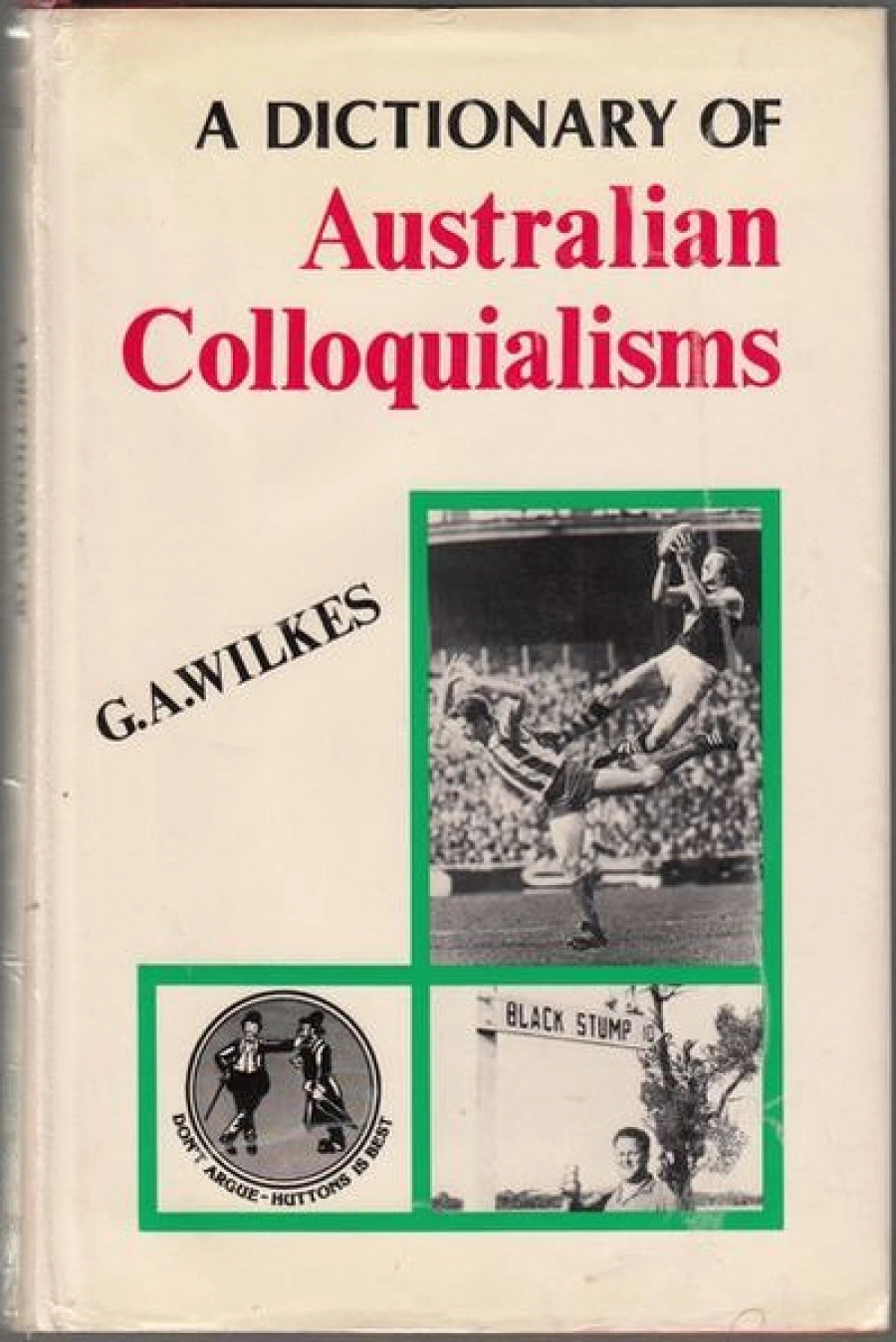
A Dictionary of Australian Colloquialisms
edited by G.A. Wilkes
Sydney University Press, $15
Leave a comment
If you are an ABR subscriber, you will need to sign in to post a comment.
If you have forgotten your sign in details, or if you receive an error message when trying to submit your comment, please email your comment (and the name of the article to which it relates) to ABR Comments. We will review your comment and, subject to approval, we will post it under your name.
Please note that all comments must be approved by ABR and comply with our Terms & Conditions.