Accessibility Tools

  • Content scaling 100%
  • Font size 100%
  • Line height 100%
  • Letter spacing 100%

Orpheus & Eurydice

An acrobatic rendering of an opera about suspension
Opera Australia
by
ABR Arts 03 December 2025

Orpheus & Eurydice

An acrobatic rendering of an opera about suspension
Opera Australia
by
ABR Arts 03 December 2025
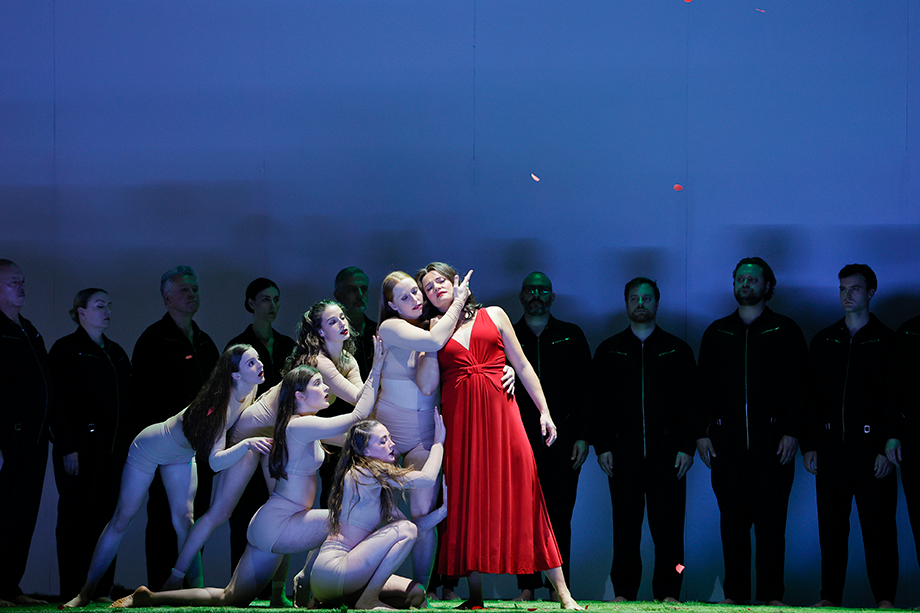
Samantha Clarke as Eurydice and Circa Ensemble (© Jeff Busby)

German baroque composer Christoph Gluck’s Orpheus & Eurydice presents several challenges for the contemporary opera director. There are only three characters, for a start. When the story opens, Orpheus/Orfeo (Iestyn Davies) has already lost his bride, Eurydice (Samantha Clarke), to a snake bite on their wedding day. She has been taken to the Underworld, to a paradise within hell. His mourning encompasses the opera’s opening half hour, before he is alerted by the figure of Amore (also played by Clarke in a key doubling) that he may have a chance to reclaim his love.

Anyone who has even the vaguest familiarity with the myth will know the offer is a poisoned chalice. Orfeo must descend into hell to rescue Eurydice, but he won’t be able to explain himself to her, nor look at her as they make their way out again. Is the world’s most ardent lover expected to remain aloof right at the moment of reunion? It is clearly not going to work out well. In fact, it’s designed not to.

This Opera Australia production – originally presented by Opera Queensland in association with Circa, one of the country’s most daring and accomplished circus companies – is directed by Circa’s artistic director, Yaron Lifschitz. It would be difficult to envision anyone doing it better. We open with a female figure suspended high above the stage, dressed in crimson, twisting in space. This is Eurydice being dragged into the Underworld, her feet reaching for the floor like Tantalus reaching for water. We will return to this image by the end, this time with Orfeo suspended feet first, bloodied and sacrificial, the personification of the Hanged Man. Between these two points hangs an opera about suspension, a life swinging in the balance.

Apart from the absence of a plot and the paucity of character, one of the biggest difficulties in staging this opera is its dramatic stasis, its poise. It isn’t that nothing happens; indeed, the most fundamental of all things is happening throughout. But, for the majority of the running time, we are suspended on the edge of action. There is tension in that equilibrium for the talented director to tease out, and Lifschitz does a superb job of navigating the subtle shifts and eddies in the music, galvanising his fearless troupe of acrobats and aerialists – whose skill follows the contours of contemporary dance as much as circus – in the service of artistic unity and vision.

Central to the effect are the glorious vocal performances from Clarke and Davies. His clarion countertenor is marvellous, effortless in its range and deeply satisfying in its warmth and texture. Orfeo’s desperation and commitment, his torment and guilt, are dramatically compelling and psychologically astute. Clarke delivers a rich and forceful Amore – a representation of love as a kind of Mistress of Misrule, teasing and malevolent – and a surprisingly detailed portrait of grief and confusion as the newly awakened Eurydice. It’s a pairing of fine artists, keen and nuanced, profoundly human even when burrowing into legend.

Setting this quintessential love ordeal in a sparsely abstracted world – the bold costumes are by Libby McDonnell and the dazzling lighting by Alexander Berlage – Lifschitz eschews movement for its own sake, preferring to augment and intensify emotional effects rather than make them literal. For this to work, the artistic disciplines of opera and circus must do more than merely collaborate: they must synthesise. Because Gluck’s piece is deliberately spare and streamlined, its characters archetypal enough to survive abstraction, the addition of circus feels less distracting than it otherwise might. But Lifschitz’s true achievement here is more complex and lasting, employing the language of circus to enhance the formalism in the music.

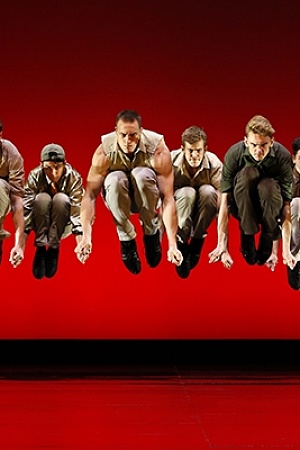
The late (great) Robert Wilson seems a major influence here, particularly in relation to the theatrical architecture underpinning this production. The choreography is intense but strictly contained, even compartmentalised. Totems rise as bodies stand on top of each other, only to collapse gracefully like ancient columns. Acrobats arrange themselves in strange god-like configurations, spinning on axes like golden weathervanes. Chorus members sway gently, wearing rictus grins straight out of horror films. It is modular, dream-like, and completely mesmerising.

After a shaky start, conductor Dane Lam leads Orchestra Victoria to a measured and regal playing of Gluck’s sublime score, highly attentive to the performances on stage but capable of flights of virtuosity. If there is a downside to Lifschitz’s arresting stage pictures and continuous movement, it is that they don’t allow for enough stillness around the music; beautiful orchestral interludes are almost lost in the visual maelstrom. Even the surtitles are co-opted into the effect, projected onto the back wall of the asylum-like set, slowly fading away like an echo.

Circa Ensemble (© Jeff Busby)Circa Ensemble (© Jeff Busby)

What, in the final analysis, does the myth of Orpheus and Eurydice mean? Is it about constancy and commitment, or hubris and mistrust? Is Orpheus a Job figure, tormented for the sin of living? Is Eurydice another Eve, tempting her lover to fall? Lifschitz wisely refuses to answer these questions, although he does have his Orfeo write ‘The Triumph of Love’ in blood on the back wall, a counterpoint to the finale’s descent into unreason. Febrile and charged with associations, Lifschitz’s vision is broad enough to countenance multiple readings, the mythological narrative acting as a tabula rasa, endlessly interpretive.

This Orpheus & Eurydice comes at a crisis point for both opera and circus, industries that face structural and artistic pressures (huge logistical requirements, high professional standards, shrinking audiences) that are so large they feel existential. This fusion of art forms won’t resolve those issues, but maybe it points to a possible future where collaboration can lead to innovation, which in turn might lead to the holy grail of artistic endeavour conjoined with cultural relevance. Neither strictly an opera nor a circus performance, this retelling of an ancient myth is an Ovidian hybrid, as beautiful and startling as it is thrillingly new.


Orpheus & Eurydice (Opera Australia) continues at the Regent Theatre in Melbourne until 5 December 2025. Performance attended: December 2.

From the New Issue

You May Also Like

Leave a comment

If you are an ABR subscriber, you will need to sign in to post a comment.

If you have forgotten your sign in details, or if you receive an error message when trying to submit your comment, please email your comment (and the name of the article to which it relates) to ABR Comments. We will review your comment and, subject to approval, we will post it under your name.

Please note that all comments must be approved by ABR and comply with our Terms & Conditions.