

Dear Son

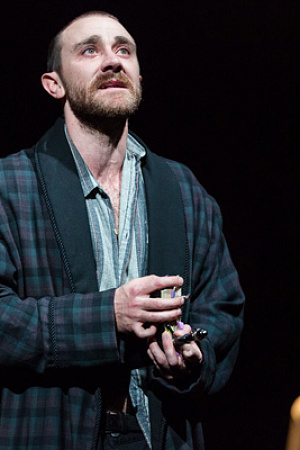
On the opening night of Dear Son at Belvoir, director and co-adaptor Isaac Drandic takes to the stage before the performance. One of the cast members is ill; on short notice, Drandic will play his role. Don’t expect a star turn, he warns. But, Drandic says, the content of the source book – a collection of twelve letters from Indigenous men to their sons, edited by Thomas Mayo and published in 2021 – will carry the show along.
The production ran twenty minutes over its scheduled seventy-five minutes, with Drandic hesitant and performing with the script. The other performances are not tight either, with lines ad-libbed, flubbed, and omitted. For all that – even because of all that – this is an immensely powerful piece of theatre. It is as schmaltzy as a sitcom’s Very Special Episode and makes no secret that it is dealing with great big themes and issues with, as the characters repeat, ’the strength of our ancestors’. Toxic masculinity is explicitly called out, and ritual chorus and dance are used to address themes of love, racism, and family.
Dear Son could easily have come over as heavy-handed, grandiose, and didactic. Instead, the sincerity of the words and the performances shines through, and the artifice and stagecraft that overlay Dear Son are in support of the play, not drowning them out.
These are real stories, acted out and embodied by men who fill them with genuine life. Drandic’s voice quivers at one point, when he is recounting an emotionally charged story of family life (and there are many of these). He falls to a whisper, his memory of ‘footsteps [that] seemed to echo between the walls’ barely audible. Rather than hampering the production, these moments of earnest emotion – men letting their distress and hurt be visible, men supporting one another, men simply ‘talking shit’ – add force.
The production’s overarching narrative sees five Indigenous men come together for a barbeque and a yarn, talking about their relationships with their fathers and with their sons, sharing stories of family life and ideas about how to live as a good man. This framing narrative, alongside naturalistic performances from the cast of Jimi Bani, Waangenga Blanco, Kirk Page, and Tibian Wyles (with Luke Carroll replaced by Drandic on the night), creates a sense of intimacy and immediacy.
Dear Son is ultimately about both the simplicity and complexity of love between men. The play’s loose narrative framework echoes the structure of many father-son relationships in Australia.
The decision to not deliver the letters as a series of monologues prevents the show from sliding into misery theatre. The at-times loose delivery contributes to the sense that these actors are having fun, and so is the audience.
As the men take turns telling stories, there are loose transitions between vignettes and acts. There are anecdotes about ‘being a champion boxer’, about riding a Malvern Star bicycle around Australia, about regretting telling your son that he is ‘too old to hold my hand in public’. But the flow of the play, and the decision not to name the characters, renders the characters, and their tales, interchangeable and universal. While these are true stories of real people, in this production they are less biographical and more representative.
It does get a little muddled, with actors jumping in and out of their primary roles to take up characters in secondary narratives. The focus, however, is less on the details of a single life, and more on the different experiences and perspectives of what it means to be a man, to be Indigenous in Australia, and that intersectional phenomenon of being an Indigenous man.
With a seventy-five-minute runtime, this is a short piece of theatre with near-constant emotional pivots. It doesn’t let the audience stick with any story for too long, and while it deals with the Stolen Generations, the Intervention, and other crucial moments in modern Australian history, it doesn’t linger on the minutiae. This is not an educational play about what has happened; it is a window into a conversation about the impacts of history, and how those impacts are being experienced and dealt with today.
Video by Craig Wilkinson and lighting by David Walters are prominent but are well-deployed in the service of the performances. The set by Kevin O’Brien, a beach shack, is busy but cramped, consuming only half of the stage. The shack thus functions, and effectively, as a backdrop. Cast member Blanco also acts as choreographer, with a handful of brief and simple dances used sparingly and effectively.
Mawkish it may be, and a little ramshackle on opening night, this production of Dear Son draws out the force and truth of Mayo’s original work.
Dear Son (Belvoir Street Theatre) continues until 25 January 2026. Performance attended: 10 January 2026.








Leave a comment
If you are an ABR subscriber, you will need to sign in to post a comment.
If you have forgotten your sign in details, or if you receive an error message when trying to submit your comment, please email your comment (and the name of the article to which it relates) to ABR Comments. We will review your comment and, subject to approval, we will post it under your name.
Please note that all comments must be approved by ABR and comply with our Terms & Conditions.