Kokuhō (★★1/2), Sunset Sunrise (★★), Chime (★★★★1/2)
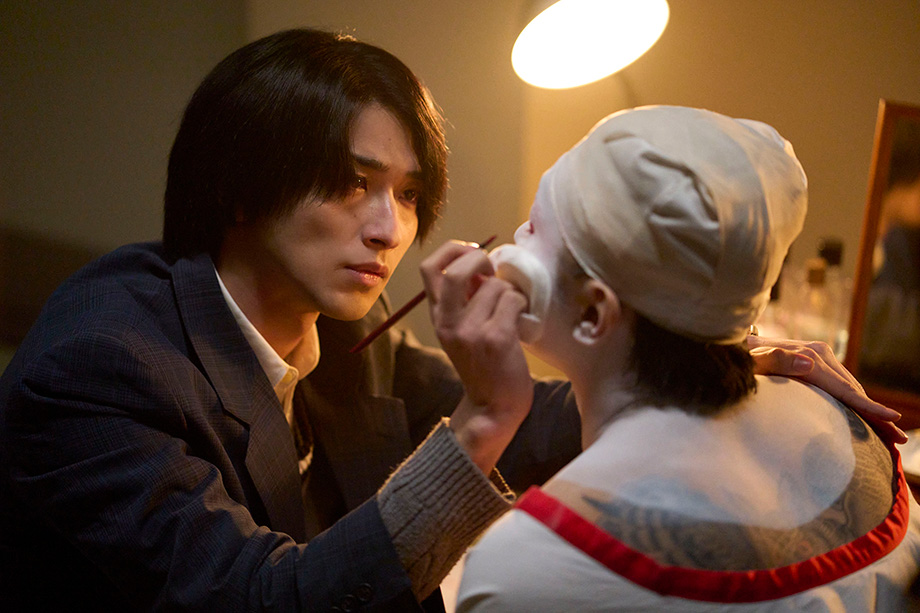
The phenomenal box office success of Lee Sang-il’s Kokuhō – a sprawling epic about the friendship and rivalry between two kabuki actors – has been regarded as something of a miracle in Japan. The surprise stems from the status of kabuki: despite being a centuries-old art form of immense cultural significance, it remains neither broadly understood nor widely appreciated.
Lee, a versatile filmmaker whose work spans multiple genres, does not set out to elucidate the kabuki tradition, nor does he weave its stylised artifice into the film’s own aesthetics, as others have done before him. His approach is to enlarge and elongate – to render kabuki as spectacle in purely cinematic terms.
The story begins in Nagasaki in 1964 and unfolds over fifty years. After the murder of his yakuza-boss father, fourteen-year-old Kikuo (Soya Kurokawa) is taken in by Hanjiro (Ken Watanabe), the foremost kabuki actor in Osaka. Under Hanjiro’s strict tutelage, Kikuo apprentices as an onnagata (female impersonator) alongside the master’s son and heir apparent, Shunsuke (Keitatsu Koshiyama) – a boy of similar age and ability, if not quite equal dedication – with whom he quickly forms a bond.
A decade or so later, the now-adult Kikuo and Shunsuke (Ryo Yoshizawa and Ryusei Yokohama, respectively) rise to prominence as a performing duo. But the symmetry of their ascent is soon disrupted by brotherly rivalry and the hereditary demands of kabuki – the complications of which Lee and screenwriter Satoko Okudera (adapting Shūichi Yoshida’s best-selling 2018 novel, also called Kokuhō) trace across the film’s three-hour duration.
Films about a cultural pursuit whose workings are not widely known (Benny Safdie’s mixed-martial-arts drama The Smashing Machine [2025] is a recent example) tend to break the central activity into digestible pieces, leaning on the surrounding drama to convey the characters’ devotion to their craft. Kokuhō, however, largely bucks this trend. Offering guidance only through title cards summarising the plot of each play, Lee affords generous screen time – roughly a quarter of the film – to the kabuki performances themselves, their length far exceeding any narrative meaning that could be gleaned from them.
These sequences are initially filmed at a modest remove, becoming more dynamic as the characters refine their craft. Eventually, the camera is given free rein to spin, glide, and cut across and beyond the stage, capturing the intricacies of each performance with ubiquitous clarity. The results are immersive and compelling, these scenes standing apart from the more conventional drama that occurs around them (and which, slowly but surely, makes its way onto the stage).
In its emphasis on sweep and spectacle, however, Kokuhō leaves much on the table. The film barely pauses to consider the intriguing gender roles at the heart of the onnagata tradition, or gender full stop, while its narrative ellipses produce some jarring shifts in character. One such turn reveals that Kikuo has fathered a daughter, to whom he seems attached, until he unceremoniously casts both mother and child out of his life a few scenes later. (Here and throughout, the female characters meekly accept their fates to make way for Kikuo’s genius.)
It is tempting to chalk up such behaviour to enigmatic detail, a symptom of an artistic obsession that will remain forever inscrutable. But, as the film progresses, it becomes clear that Lee is convinced that a great artist (or ‘national treasure’, per the title’s translation) can be a good person or an ambitious one, but never both; that whatever suffering they inflict along the way is not only inevitable but worth it in spades. For a film that deploys all the pizzazz of modern filmmaking to make an old art form new, it is a decidedly antiquated stance.
Masaki Suda as Shinsaku and Mao Inoue as Momoka in Sunset Sunrise (photograph ©Shuhei Nire/KODANSHA, courtesy of the Japanese Film Festival Australia)
Yoshiyuki Kishi’s romantic comedy Sunset Sunrise unfolds in a far more contained setting than Kokuhō, yet it results in something far more unwieldy. When the pandemic creates an opportunity for remote work, zestful salaryman Shinsaku (Masaki Suda) seizes the chance for a sea change, relocating from Tokyo to Udahama, a small town on the north-eastern coast. There he meets a roster of kooky locals, most of whom regard him with suspicion before gradually warming to his charms (and he to theirs). Chief among them is his landlord and lover-to-be, Momoka (Mao Inoue), a kind but guarded council worker who, like many in the community, lost loved ones to the earthquake and tsunami that devastated the region a decade earlier.
The film treats this recent tragedy with solemn respect, as one might expect. By contrast, the even more recent pandemic is rendered harmless, serving only to engineer plot points and elicit chuckles. Shinsaku flippantly breaches self-isolation because he is a keen fisherman, and fish can’t be caught indoors, while his initial encounter with Momoka presents a woman gripped by an obsessive concern for hygiene. Only when she later removes her face mask – allowing Shinsaku, at last, to see her for who she really is – does he begin to fall for her. These jabs at Covid anxieties, delivered from the safety of hindsight, strike a weird note in a film otherwise committed to promoting the virtues of neighbourly care.
After a plodding first half, the film briefly comes alive when Shinsaku and Momoka set out to revive the many abandoned houses in the area, refitting them as rentals to entice city dwellers to move to the region. These sequences yield some thoughtful reflections on Japan’s depopulation crisis, along with touching moments that evoke the lingering impact of the disaster through everyday items left by the deceased. Yet the shift to pathos feels awkward, burdened by sentimental dawdling and a sudden demand for sincerity from the hitherto goofy cast.
The same goes for the recurring emphasis on food. While not unusual for a Japanese film director, Kishi seems determined to showcase the regional cuisine in its entirety, cataloguing dish after dish with close-ups and tableside explanations (some even include suggested drink pairings) that have little bearing on the film beyond halting its momentum. Like these delicacies, Sunset Sunrise contains some fine ingredients – a talented cast, gorgeous rural settings, globally resonant themes – but somehow ends up as a leftover stew.
Mutsuo Yoshioka as Matsuoka in Chime (photograph ©Roadstead, courtesy of the Japanese Film Festival Australia)
Kiyoshi Kurosawa’s Chime suffers from none of the same bloat across its forty-five-minute running time. Of the director’s three most recent works – all released in 2024, the others being Cloud and Serpent’s Path, the latter a French remake of his 1998 feature – Chime is the leanest and the most potent: an abstract, deeply unnerving horror film that ranks among his greatest.
The plot serves mainly as a pretext for atmosphere, which Kurosawa prioritises above all else. Matsuoka (Mutsuo Yoshioka), an unassuming instructor at a Tokyo culinary school, notices a student, Tashiro (Seiichi Kohinata), behaving oddly during class. When approached, the young man claims to hear a chime – ‘like a human scream’ – through which something is trying to send him a message. Matsuoka calmly deflects his ramblings but, at their next lesson, Tashiro collects his knife and takes his own life, his terrified classmates watching on.
Kurosawa’s horror films are often marked by a malaise that spreads like a virus, governed by a logic that always remains out of reach. Chime follows a broadly similar trajectory: whatever had afflicted Tashiro seems to rub off on Matsuoka, though cracks appear long before the teacher takes his own violent turn. After Tashiro’s suicide, Matsuoka stretches and yawns in the kitchen with insouciant indifference. At home, he mentions nothing of the incident to his wife (Tomoka Tabata), who maintains an air of middle-class normality – that is, until she suddenly rushes from the dinner table to ditch the recycling, performing the chore in a kind of robotic trance.
As the narrative grows increasingly opaque, the film hovers delicately between the ordinary and the uncanny, imbuing every shot with ambiguity. Throughout, Kurosawa conjures his customary dread through the simplest means – a flicker of light, a vague noise, a pan to an empty chair (the film’s closest equivalent to a jump scare) – which might risk ridicule in lesser hands.
All manner of ideas are teased into the mix, ranging from mental illness and career anxiety to ghostly malevolence. None of them can account for just how askew Chime’s quotidian world feels. The film’s chilling thesis is that evil – whether it arises from within or descends from elsewhere – remains fundamentally unknowable.