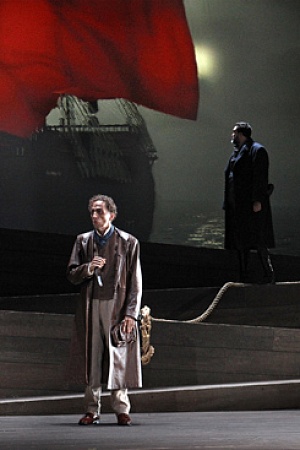
Turandot
Last year marked the anniversaries of perhaps the two greatest male singers of the late twentieth century: the renowned German baritone, Dietrich Fischer-Dieskau, born one hundred years ago, and the great Italian tenor Luciano Pavarotti, who would have been ninety. Fischer-Dieskau has the largest discography of any classical singer in history and possesses an astonishing range. Pavarotti is primarily known for Italian opera.
But where Pavarotti decisively eclipses Fischer-Dieskau is in popular recognition. A single event captured this disparity: the concert in the Baths of Caracalla in Rome in July 1990, staged to celebrate the opening of the FIFA World Cup. Televised throughout the world and billed as a ‘once in a lifetime event’, it was subsequently performed in venues throughout the world. It had a finale most would remember – the aria ‘Nessun dorma’ from Puccini’s Turandot, performed by Pavarotti and his illustrious Spanish colleagues, Placido Domingo, and Jose Carreras. Yet, it was Pavarotti’s ringing high B that concludes this famous aria on the word ‘vincerò’ (‘I will win’) that was – and remains – the most defining moment of all.
Turandot and its gestation are shrouded in myth and legend, and the work was left unfinished at Puccini’s death in 1924. Structured around the successful answering of riddles, perhaps the most persistent puzzle of all is how Puccini intended to complete it. At his death, he left some musical sketches for the ending, which was finally completed by Franco Alfano (1875-1954). During the La Scala premiere on 26 April 1926, the performance ended after Liù’s death in Act Three, the last music Puccini completed in full. Conductor Arturo Toscanini silenced the orchestra, put down his baton, and addressed the audience: ‘Here the opera ends, because at this point the Maestro died.’
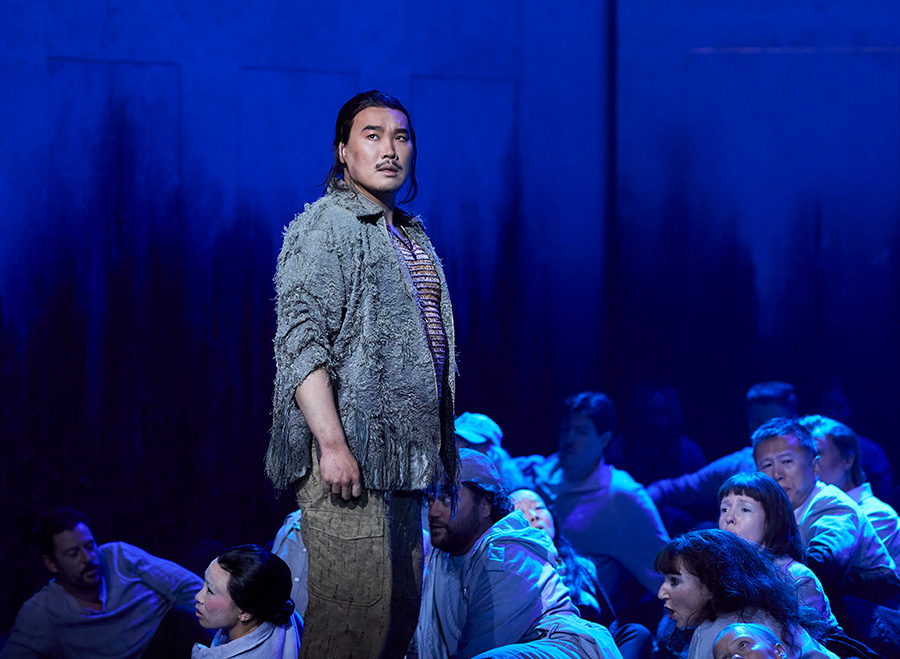 Young Woo Kim as Calaf in Turandot (photograph courtesy of Opera Australia)
Many commentators regarded this performance as possibly the most important in the history of the illustrious theatre. Mussolini declined to attend after Toscanini refused to conduct the Fascist anthem ‘Giovinezza’ in Il Duce’s honour. A further irony is that Puccini’s last opera to be premiered at La Scala, Madama Butterfly (1904), had been soundly booed off the stage.
Following Graeme Murphy’s much-loved and oft-revived 1990 production, Opera Australia has staged a new version by celebrated American director and choreographer Ann Yee, with sets by Elizabeth Gadsby, costumes by David Fleischer, and lighting by Paul Jackson. Chinese American visual artist Andrew Thomas Huang created an avatar for Turandot. Yee’s stated aim is to offer new perspectives on this ever-popular repertoire work, often distinguished by lavish spectacle but constrained by limited characterisation and psychological depth. Yee notes: ‘Key to the fresh perspective is the avatar Huang has created, a digital projection of Turandot to communicate to her people, but to protect herself, too.’
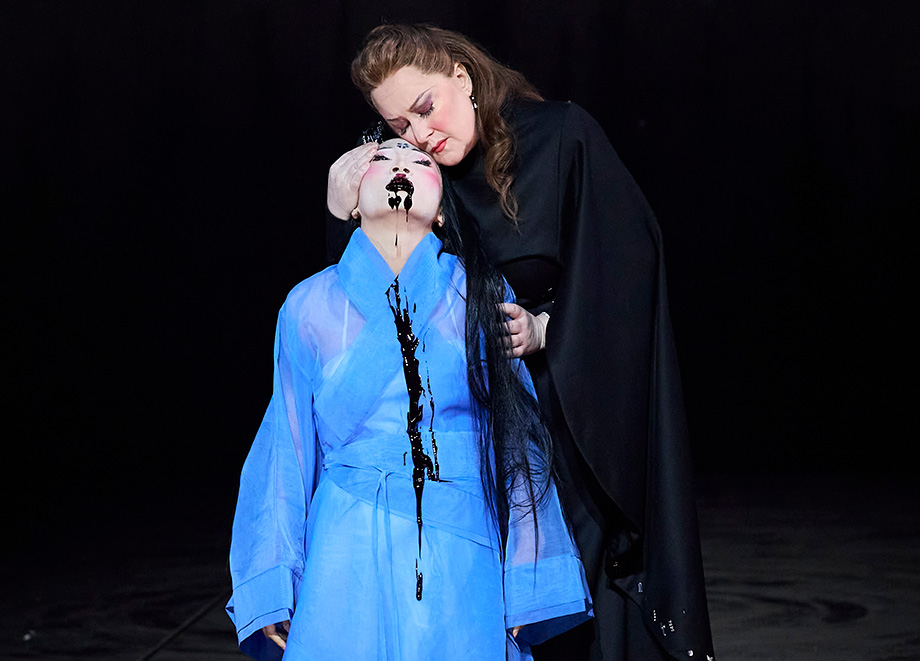
A parallel strategy is Yee’s decision to stage the figure of the raped and murdered Princess Lou-Ling, the ancestor that Turandot invokes, who does not feature in the opera but whose story helps explain Turandot’s coldness and resistance to love, suggesting profound intergenerational trauma. The performance opens in silence with dancer Hoyori Maruo representing an anguished Lou-Ling, blood pouring from her mouth and embraced by Turandot. Together they retreat into the darkness. The minimalist settings – no gilded palaces or costumes here – avoid the obvious temptation of over-elaborate chinoiserie. The rotating sets provide a versatile playing space while suggesting the drab concrete structures of a bleak authoritarian society.
Conductor Hungarian Henrik Nánási evokes Puccini’s multi-hued sound world with precision and a sure sense of style. Many conductors admit to finding Puccini challenging, but there was good connection between stage and pit, the orchestra revelling in Puccini’s vivid orchestration. As ever, Opera Australia’s chorus and the Opera Australia Children’s Chorus were outstanding, providing wide-ranging vocal colours and sonorities in their pivotal roles throughout the opera. The choreography of chorus and dancers was most effective.
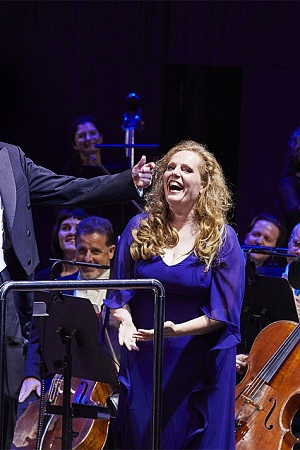
Australian soprano Rebecca Nash is Turandot. She enjoys a stellar international career, including stints playing Turandot and Electra at the Metropolitan Opera. Her first performance in Australia in twenty-six years, she revealed a voice with the steely sinew necessary for the role, as well as the colour and flexibility that make this a believable character whose final embrace of love is plausible. Her voice has an appealing Nordic astringency, and her commanding stage presence conveys the terrifying inflexibility and ruthlessness of the character, somewhat softened in this production with the brutal torture of Liù left unstaged.
South Korean tenor Young Woo Kim was a heroic-toned Calaf, possessing the burnished Italianate ring and squillo that the role demands. He has a powerful and untiring voice, with an imposing physical presence and vocal flexibility in his interactions with both Turandot and Liù. He displays excellent control and great tonal beauty, particularly in his luminous soft singing. And yes, as expected, he delivered a thrilling ‘Nessun dorma’ in Act Three; it was a superb vocal performance.
Italian soprano Maria Teresa Leva is a compelling Liù, with appealing vocal warmth and soaring phrasing guaranteed to endear her to the audience. Her final scene had all the beautiful tone and pathos that one could hope for, and she possesses a winning stage persona, ideal for this much-loved role. Liù and Lou-Ling’s encounter at the end suggests their collective suffering might finally heal the pervasive societal trauma.
Luke Gabbedy, John Longmuir, and Michael Petruccelli play Ping, Pong, and Pang, respectively, demonstrating vocal diversity in their portrayal of these comic but sad characters and displaying excellent ensemble singing in Act Two. They oversee the retro technology which controls Turandot’s avatar and creates the oppressive world of the opera. Richard Anderson was an imposing and moving Timur. Shane Lowrencev (the Speaker) and Gregory Brown (the Emperor) were convincing, while Annabelle Chaffey and Leah Thomas (the Attendants) and Thomas Dalton (the Prince), delivered strong vocal and dramatic performances.
One might regard ‘vincerò’ as the last triumphant utterance of the great Italian operatic tradition. Contemporary opera exists in a fragmented world, making it unlikely that another Puccini-like figure will emerge. However, Calaf’s high B will continue to resound through what one hopes is a glorious future for this great art form. Opera Australia has served Puccini well in this austere and thought-provoking production.
Turandot continues at the Sydney Opera House until 27 March 2026. Performance attended: 15 January 2026